You can have many interests. How many projects can you actually build?

At one point this year, I was building 3 businesses at the same time.
One was a software product. Another was a website business. And I was doing freelance work on the side.
I had plans for all 3.
And whenever I got tired of working on one, I'd find something interesting to do on another.
It felt good having so many things going on. I was always busy, always learning something and constantly thinking about what I could build next.
But when I looked at how much progress I was making, I started noticing a problem.
I was spending a lot of time starting things and very little time seeing them through.
I recently came across a letter by Dan Koe called If you have multiple interests, do this.
Dan talks about how having several interests can work in your favour.
You might enjoy learning about business, psychology, technology and art. Over time, you start noticing connections between those subjects and developing your own way of looking at things.
And because it's become so easy to publish online, you can share what you're learning with other people.
He calls the place where you bring all those interests together a vessel.
For some people, that might be a YouTube channel. For others, a newsletter or personal brand.
I liked the idea because it made me think about something I'd been struggling with.
You can have as many interests as you like. But every project you start needs time from the same 24 hours you have each day.
The excitement of starting something new
Think about the last time you had an idea you were really excited about.
Maybe you wanted to start a YouTube channel or build a business.
You probably spent hours researching it.
You watched videos, thought of a name and started making plans for how everything would work.
You could spend an entire weekend doing this without getting bored.
I've experienced that feeling with almost every business I've started.
I'd come up with a name, design a logo and start working on a website.
Then I'd think about what the business could become once it started making money.
I enjoyed that part.
But eventually, I had to start doing the work that would actually get the business off the ground.
Finding customers. Sending messages to people I'd never spoken to. Figuring out how much to charge.
Some messages got ignored. Others led nowhere.
And there were days when I'd spend hours working without seeing much progress.
That's usually when another idea would start looking interesting.
I'd tell myself it was a good opportunity worth exploring.
So I'd start researching it.
And suddenly, I had that excitement back.
Dan talks about experiencing something similar with learning.
He describes getting stuck in what he calls tutorial hell, where you spend so much time learning new things that you struggle to put any of them into practice.
I think I've had my own version of that with starting businesses.
I'd get excited about an idea, spend weeks getting everything ready and then lose interest when the work became repetitive.
And because I always had another idea waiting, starting again was easy.
Too many open tabs
Think about how many tabs you have open in your browser right now.
There's probably an article you meant to read, a video you wanted to watch and a website you opened while researching something last week.
You leave them open because you plan to come back.
Then you open a few more.
Eventually, you've got so many tabs that you can't remember what half of them are for.
That's what having too many unfinished projects started to feel like for me.
Even when I was working on one business, I'd be thinking about something I needed to do for another.
I'd remember a website I hadn't finished or a potential customer I still needed to contact.
And I'd keep telling myself I'd get around to it when I had more time.
The problem was that every project needed my attention.
I couldn't spend an entire day working on one without feeling like I was neglecting the others.
So I'd jump between them.
At the end of the week, I'd been busy with all 3 businesses, but it was difficult to point to anything meaningful I'd accomplished.
And that's frustrating when you've already put so much time into getting those ideas started.
Some of them might have worked.
I just hadn't given them enough time to find out.
Learning to separate interests from projects
This is where Dan's idea of having a vessel started making sense to me.
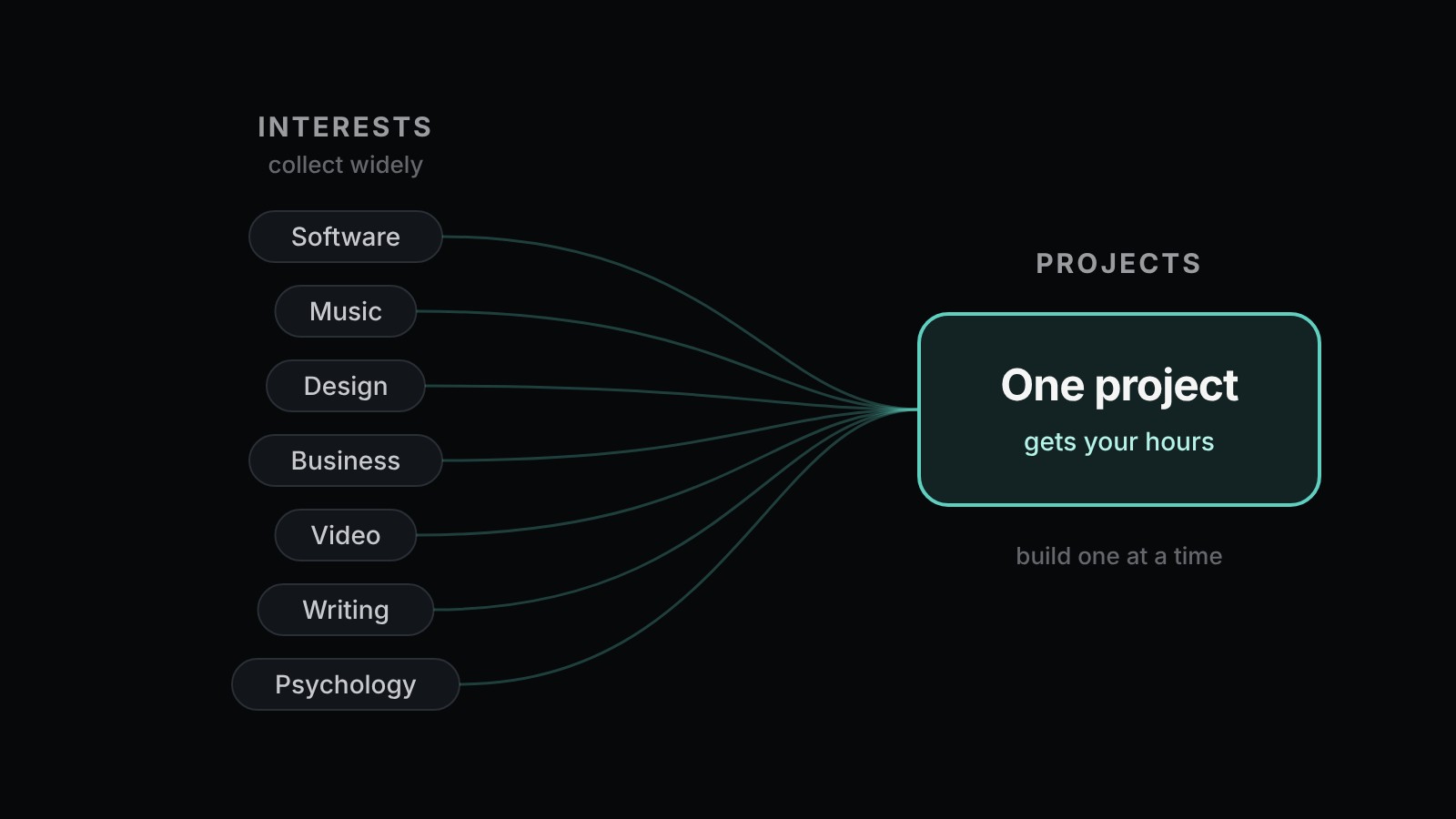
You can be interested in software, music, design and business.
You can spend your weekends reading about those things, trying them out and sharing what you've learned.
There's nothing wrong with being curious about several subjects.
The difficulty comes when you decide that every interesting idea deserves its own project.
Because a project comes with responsibilities.
If you're building a business, you have customers to find, work to deliver and people to follow up with.
If you're running a YouTube channel, you need to keep making videos, even when the previous ones haven't performed well.
And if you're learning a skill with the intention of using it professionally, you need time to practise and get better.
All of those things compete for your attention.
I've started asking myself a question whenever I get excited about something new.
If I stopped working on this for a month, what would happen?
Would someone be waiting for work I'd promised to deliver?
Would I miss a deadline or lose an opportunity I'd already been working towards?
If so, I know it's something that needs a place in my schedule.
But if it's an idea I'm simply curious about, I can write it down and come back to it when I have time.
I don't have to turn it into another business immediately.
Giving one thing enough time
I've realised that I can probably only give 1 major project my full attention at a time.
Maybe 2 when things are going well.
And I'm trying to become more careful about what I commit to.
For me, The Needle and my personal brand are becoming a long-term project I want to keep building.
I still work on software, websites and video editing.
Those projects are part of how I earn money, develop my skills and learn about running a business.
And the things I experience while doing that work give me plenty to write about here.
I can share what I'm learning about finding customers, building products and figuring out what works.
It gives my different interests somewhere to come together.
I'm also trying to get better at how I manage my time.
I've started using a timer to see how many hours of focused work I actually get done.
I set aside time to approach potential customers and pitch my services.
I keep a record of the people I've contacted so I know when to follow up.
And I track what I've completed during the week.
It's fairly ordinary stuff.
But when you're working on your own projects, it's surprisingly easy to spend an entire day doing little things and still feel like you've accomplished a lot.
Having a record of what I've done helps me see where my time is going.
I also came across a similar idea from Alex Hormozi in You Can Have Everything You Want in 90 Days.
The part that stuck with me was the idea of choosing something and giving it a proper chance.
I think that's especially useful if you're someone who gets excited about new opportunities.
Because there will always be another interesting idea.
Another business you could start. Another skill you could learn. Another opportunity that seems worth exploring.
And some of those ideas might genuinely be good.
You can keep them somewhere and return to them when you have the time.
For now, there's probably something you've already started that deserves a little more of your attention.
This week's 5-minute move
Write down every project you've started but haven't finished.
Include the ones you haven't touched in months.
Now look at your list and choose one that you still believe is worth pursuing.
Ideally, pick something where you've already done enough work to be reasonably close to a result.
Give that project your attention for the next 30 days.
Move the others to a separate list and set a date to review them.
You can always return to those ideas later.
For now, see how much progress you can make when you give one project the time you've been spreading across several.